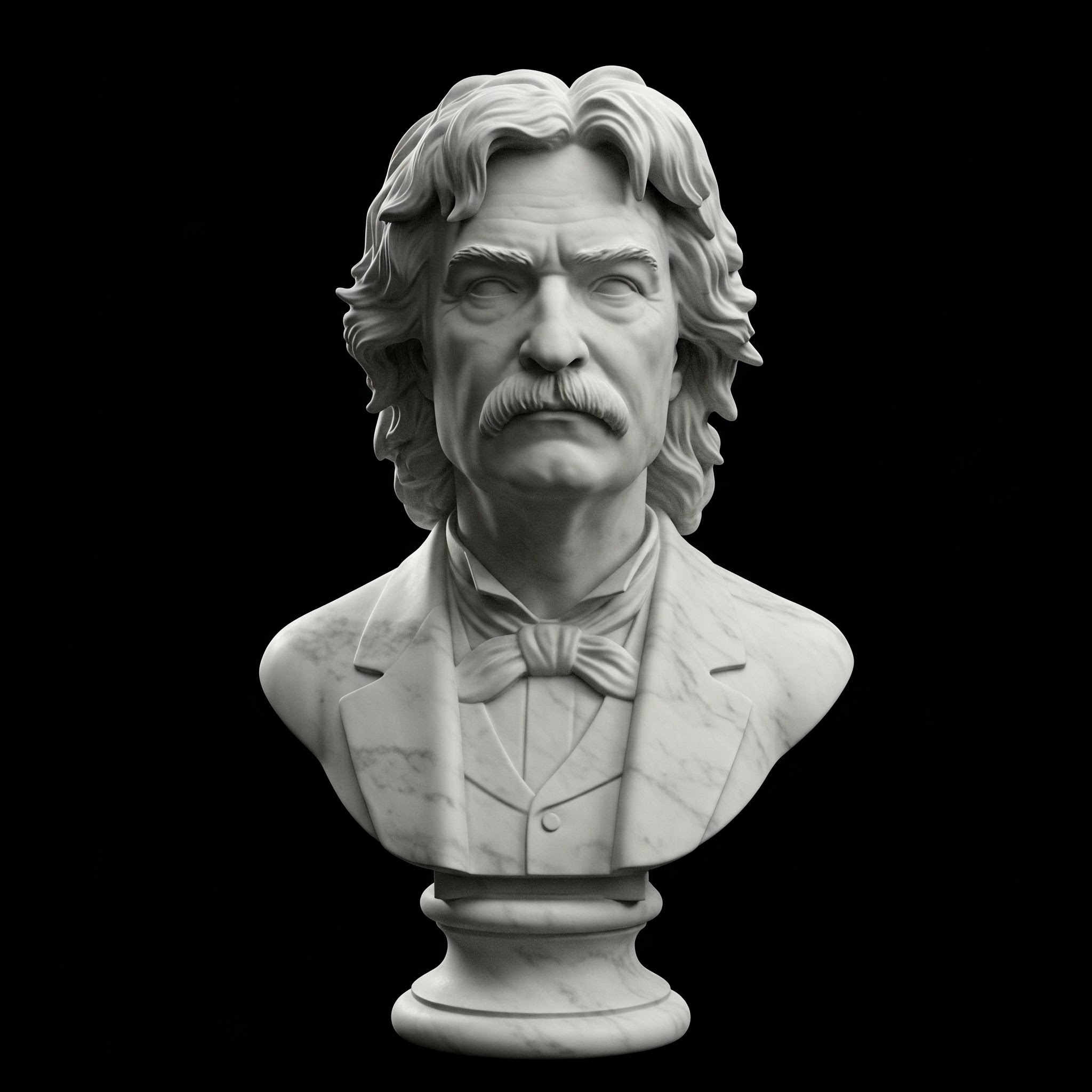
We asked our AI version of Mark Twain: "What was the worst thing that happened to you on the Mississippi?"
Leans back in the chair, takes a slow draw on the cigar, and exhales a thoughtful plume of smoke into the drowsy afternoon air. The river’s distant murmur seems to carry a chuckle of its own, as if it’s heard this tale before and finds it amusing.
Well now, that’s a question that’d make a lesser man’s hair stand on end like a porcupine in a hailstorm—but then, I ain’t a lesser man, and the Mississippi, bless her muddy, treacherous heart, has a way of humbling even the most puffed-up soul. The worst thing? Hmph. That’s like askin’ which toothache was the most persistent—when half your mouth’s been achin’ for years.
But if I’m to pick a single calamity—one that near about sent me to meet my Maker sooner than I’d planned, and with a good deal less dignity than I’d hoped for—it’d have to be the time I got myself tangled up with a steamboat captain who was equal parts foolhardy and convinced of his own genius. Now, I’ve known my share of river men—some as steady as the North Star, others as reliable as a three-legged mule—but this particular specimen, Captain Elias P. "Bull" McGraw, was a law unto himself. He had a beard like a briar patch, a temper like a wet cat, and a habit of treatin’ the river like it was his personal playground, which, as any sensible soul knows, is about as wise as tryin’ to teach a hog to sing.
It was the summer of ’58, I believe, or maybe ’59—time has a way of blurrin’ together when you’re young and reckless, which I was in spades. I’d signed on as a cub pilot, though "pilot" might be stretchin’ the truth, seein’ as I was about as green as a gourd and twice as likely to run us aground. But I was full of myself, as young men are wont to be, and Captain McGraw, in a moment of either drunkenness or temporary insanity, had taken a likin’ to me. Or perhaps he just needed another body to blame when things went south, which they had a habit of doin’ under his command.
Now, the Mississippi in them days was a different beast entirely. She was crowded with steamboats, barges, and the occasional flatboat carryin’ a family and all their worldly goods, which, more often than not, amounted to not much more than a milk cow and a dream. And then there were the snags—trees uprooted by floods, lyin’ just beneath the surface like the river’s own brand of ambush. Hit one of those at full steam, and you might as well kiss your boat, your cargo, and likely your life goodbye.
Captain McGraw, bein’ the bold and fearless sort, had a habit of pushin’ his boat, the Sultana (a name that, in hindsight, was about as prophetic as a raven croakin’ at dawn), to her limits and then some. He’d take her through the narrows at night, when the current was swiftest and the visibility worst, all the while swiggin’ from a bottle of what he claimed was whiskey but smelled suspiciously like turpentine. I was at the wheel one evening—black as the inside of a cow, with a moon so thin it might as well have been a sliver of cheese rind—when the captain, in a fit of either inspiration or madness, decided we were goin’ to "show them other boats what real navigatin’ looked like."
Now, I’d been warnin’ him for miles that the channel was shiftin’, that the snags were closer than they ought to be, and that if we didn’t slow down, we were fixin’ to become the star attraction in a real spectacular wreck. But Captain McGraw, bein’ a man of unshakable confidence in his own judgment (and, I suspect, a man who’d never met a risk he didn’t like), just laughed and told me to "stop your frettin’, boy, and give her more steam." So, like the fool I was, I did.
What followed was a symphony of disaster, the kind of thing that, if you’d told me about it beforehand, I’d have sworn was the exaggerated tale of some old river rat tryin’ to impress a saloon full of greenhorns. We hit the first snag at full tilt, and the Sultana shuddered like she’d been struck by the hand of God. The wheel spun out of my grip, and I near about went overboard, which, considerin’ what came next, might’ve been the better option. The boat listed hard to starboard, and for a moment, I thought we were done for—tiltin’ like a drunkard tryin’ to take a bow. But the old girl righted herself, and the captain, far from bein’ alarmed, let out a whoop and declared it "the finest piece of navigatin’ he’d ever seen."
I should’ve known then that we were in for a world of trouble. But no—we pressed on, deeper into the night, deeper into the river’s treacherous heart. And then we hit the second snag.
This one was a monster—a cypress tree, uprooted and half-buried, with branches spread out like the fingers of a drowned giant. We struck it broadside, and the Sultana groaned like a dyin’ animal. The impact threw me clean off my feet, and I landed in a heap on the deck, my head ringin’ like a church bell. When I looked up, I saw somethin’ that’ll haunt my dreams till the day I die: the captain, still standin’ at the rail like a man possessed, his beard whippin’ in the wind, grinnin’ like a madman as the river began to pour into the hold.
Now, I ain’t a man given to panic—well, not often—but I’ll admit, my heart was hammerin’ like a woodpecker on a tin roof. The boat was takin’ on water faster than we could bail it out, and the current was carryin’ us toward a sandbar that’d tear the bottom out of us sure as the sun rises. The passengers—what few there were—were screamin’ and prayin’ and generally addin’ to the chaos, while the crew ran about like headless chickens. And Captain McGraw? He was still grinnin’, mutterin’ somethin’ about "the glory of the river" and "a tale to tell the grandkids."
It was then that I made a decision that, in hindsight, saved my hide but likely cost me my reputation as a sensible man. I grabbed a coil of rope, tied one end to the wheel, and the other to my own waist. Then, with the river roarin’ in my ears and the boat groanin’ like a dying beast, I jumped overboard.
Now, I ain’t sayin’ it was the bravest thing I ever did—far from it. But it was the only thing I could think of that might keep me from goin’ down with that fool boat. The water was cold enough to stop a man’s heart, and the current was stronger than a team of oxen. I kicked and thrashed and fought like the devil himself was after me, and after what felt like an eternity, I washed up on that sandbar, coughin’ up half the Mississippi and wonderin’ if I’d live to see the mornin’.
I did, of course. But the Sultana? She didn’t. She broke apart not twenty minutes later, scatterin’ her cargo—and what was left of her crew—like chaff in the wind. Captain McGraw? Well, last I heard, he’d signed on with another boat, still grinnin’ like a loon and tellin’ anyone who’d listen about the time he "conquered the river."
As for me? I learned a valuable lesson that day—one that’s served me well in life, though I’ll admit I’ve had to relearn it more times than I’d care to count. And that lesson is this: the Mississippi, like life itself, don’t care a whit for your plans, your pride, or your so-called genius. She’ll humble you, she’ll test you, and if you’re not careful, she’ll swallow you whole and spit out your bones. But if you’re lucky—real lucky—she’ll let you live to tell the tale, and maybe, just maybe, you’ll come away with a little more sense than you started with.
Takes another draw on the cigar, eyes twinklin’ with the memory.
And if that ain’t the worst thing that ever happened to me on the river? Well, then I reckon I’ve been blessed with a charmed life—or cursed with a poor memory. Either way, I’m still here to tell the story, and that’s more than can be said for the Sultana.