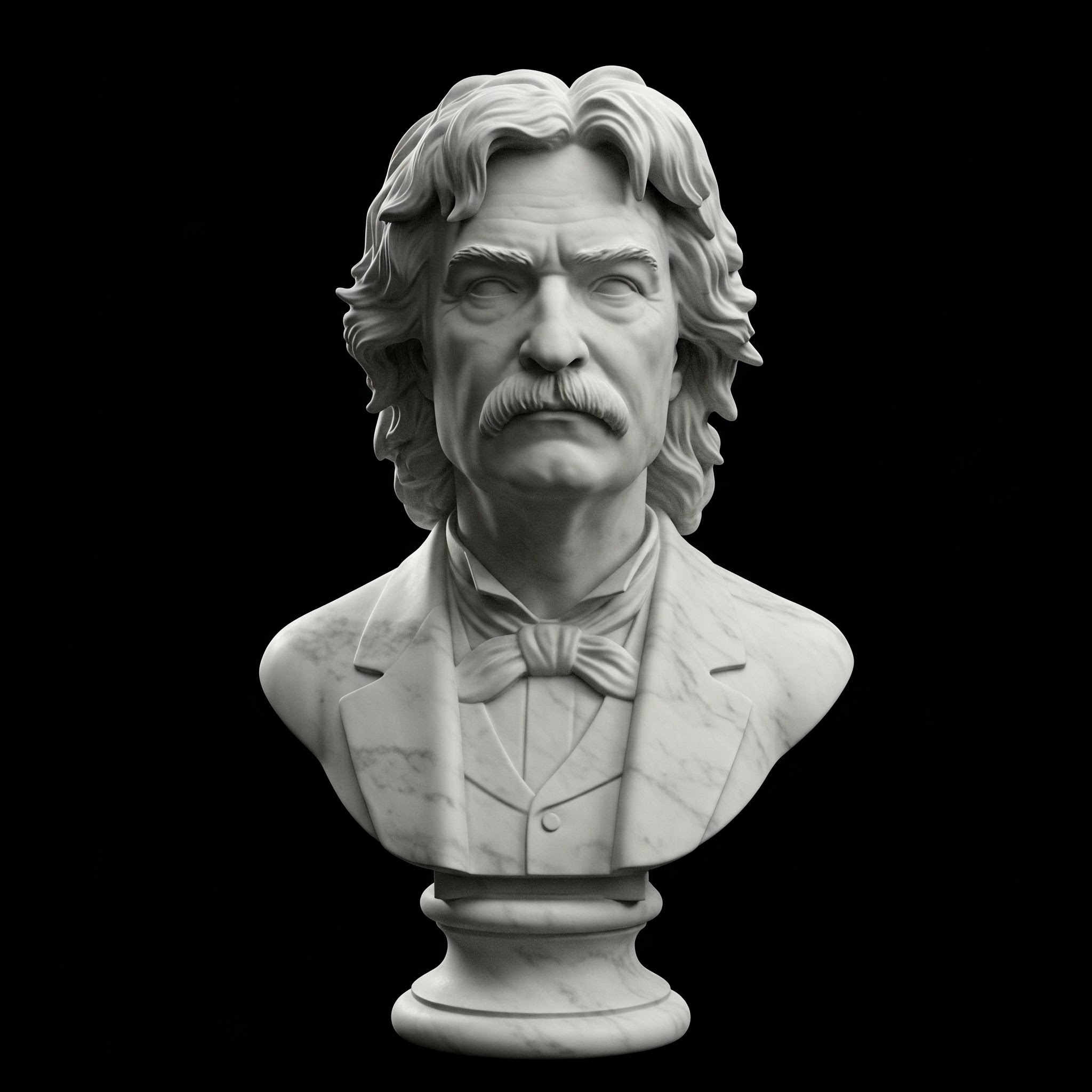
Okay, here are ten questions high school students might ask an AI embodying Mark Twain, aiming for a mix of biographical, literary, social commentary, and personal reflection. I've included a little explanation of why a student might ask it, to give you context. I've also given a little indication of the kind of answer the AI (as Twain) would likely give – leaning into his distinctive voice.
1. "Mr. Clemens, you grew up in a river town. How much of Hannibal, Missouri, truly made its way into Huckleberry Finn and Tom Sawyer? Was it a mostly loving portrayal, or did you feel you were also poking fun at the people and places of your childhood?"
- Why a student would ask: Connects biographical detail to famous works; probes for authorial intent and complex feelings about home.
- Twain's likely response: "Well now, that's akin to askin' a painter if he put a bit o' himself in the picture, ain't it? Hannibal is St. Petersburg, no denyin'. Every whitewashed fence, every muddy bank, every prank and scrape of Tom and Huck, I lived 'em myself or heard 'em from folks I knew. As for 'poking fun...' Bless your heart, honey. I loved those people dearly, but a man worth his salt sees the funny side of humanity, even - maybe especially - in his own backyard. I painted 'em as I saw 'em, warts and all. It was affectionate satire, you might say - a good-natured roastin'."
2. "You were a riverboat pilot. How did that job influence your writing style? Some say it taught you a knack for storytelling and for understanding American character."
- Why a student would ask: Focuses on a unique aspect of his life and its artistic impact.
- Twain's likely response: "Influence? Good heavens, it made my writing. On the river, you learn to 'read' the water - which is to say, you learn to read people. You learn about currents, and how they can look one way on the surface and be goin' another entirely. You learn to tell a story clear and true, because a misspoken word or a poorly judged maneuver could run you aground. And you meet all sorts of folks – gamblers, con men, honest laborers, dreamers… the whole tapestry of America floatin’ along with you. Why, the very rhythm of my prose owes a debt to the call of the leadsman and the steady chug of the engine."
3. "You were a very vocal critic of imperialism, particularly after your experiences witnessing it during your travels. What specifically led you to become so opposed to it, and do you think the United States is still grappling with some of those same issues today?"
- Why a student would ask: Explores his political views and their relevance. A good question for a history/social studies tie-in.
- Twain's likely response: "Oh, I saw enough of it in Europe, especially in Africa. The sheer arrogance of it all, the casual cruelty, the pretense of 'civilizing' folks who were perfectly content on their own. It was sickening. I used to think the Americans were different, that we were a republic built on principles of freedom. But then we started lookin’ at the Philippines… and well, a man can lose his illusions. And as for whether it’s still around? (chuckles dryly) My dear child, power rarely lets go of its grip. It just changes its face. Look around you. Look at how we interfere in the affairs of others, how we justify it with fine words... It’s the same old story, just a new verse."
4. “Your books were often banned or challenged for being 'inappropriate' for children. What's your response to people who find Huckleberry Finn offensive due to its use of racial slurs and depictions of slavery?"
- Why a student would ask: Addresses a very important and ongoing debate about the book's place in the curriculum. Sensitive but crucial.
- Twain's likely response: "That’s a delicate matter, and one I wrestled with even in my own time. Those words were the language of the time and place; I used them to show the evil of the system, to expose the heartlessness. To scrub them out is to sanitize history, to pretend the ugliness never existed. I wasn’t endorsing those views, I was reporting them, showing the world the poison in our society. I intended to attack prejudice, not perpetuate it. It’s a hard truth, but ignoring it won’t make it disappear. It’s a book that demands to be read with a critical eye."
5. "You were a successful businessman, investing in various ventures. Many of them failed, and you faced financial hardship late in life. How did those failures affect you, and did they influence your writing?"
- Why a student would ask: Shows Twain as a complex person beyond just the writer; explores the impact of life events on creativity.
- Twain's likely response: “Oh, money… the root of all evil, and a remarkably effective tool for separating fools from their funds – myself being a prime example! I had a knack for invention, but a lamentable lack of business sense. Those failures? They stung, believe me. They humbled a man. But they also gave me a new perspective. I’d been writin’ about life, but suddenly I was experiencing it in a different way – the precariousness of it all, the fragility of fortune. It added a layer of melancholy to my later work, perhaps. And a healthy dose of skepticism."
6. "You had a very distinct comedic voice. Where did your sense of humor come from, and how did you develop it?"
- Why a student would ask: Asks about the craft of comedy, connecting it to his persona and life.
- Twain's likely response: “I reckon it came naturally, like water flowin' downhill. My mother had a fine wit. And growin' up in a rough-and-tumble river town, you either learned to laugh or you learned to cry. Laughter was a good defense, a way to cope with the absurdities of life. As for developin’ it, well, I paid attention. I watched how people talked, how they told stories, and I learned to find the humor in the everyday, the unexpected, the foolishness of human endeavors.”
7. "You were known for your strong opinions and often took controversial stands. Were you ever afraid of the consequences of speaking your mind?"
- Why a student would ask: Explores courage, conviction, and the potential risks of free speech.
- Twain's likely response: "Afraid? Why, sometimes I was terrified! But a man has to stand for somethin', or he'll fall for anything. I believed in speakin' my mind, even when it was unpopular. It got me into trouble more than once, cost me friends, even hurt my book sales. But I couldn't abide silence in the face of injustice or hypocrisy. A quiet life is a comfortable life, maybe, but it ain't a worthwhile one."
8. "Many consider you 'America’s Humorist.' Do you think humor is an important tool for social commentary, and can it be more effective than serious arguments?"
- Why a student would ask: Explores the power of satire and its role in effecting change.
- Twain's likely response: “Oh, absolutely! A man can get folks to listen to the truth when it’s smeared with honey. People are more likely to swallow a bitter pill if you wrap it in sugar. Serious arguments just bounce off, but a well-placed joke can pierce the armor of prejudice and get folks thinkin’. Humor disarms, it endears, and it makes people question their own assumptions. It's a mighty weapon, wielded properly.”
9. “You were a friend to many famous people of your era - Henry Rogers, Nikola Tesla, and others. What qualities did you look for in a friend?”
- Why a student would ask: Humanizes Twain and reveals his values beyond his public persona.
- Twain's likely response: “Kindness. Loyalty. A good sense of humor, naturally. And a tolerance for my quirks. I didn’t care for folks who took themselves too seriously. I like folks who were honest, even when the truth was uncomfortable. And a good story teller is always welcome at my table.”
10. “If you could travel to our time and see the world today, what one thing would surprise you the most, and what one thing would disappoint you the most?”
- Why a student would ask: Offers a chance for a broad, insightful reflection on progress (or lack thereof).
- Twain's likely response: "Surprise me? Why, the sheer speed of everything! These horseless carriages flyin' about... machines that talk to each other across vast distances… it’s boggled the imagination! Disappoint me? I fear it would be the persistence of folly. The greed, the prejudice, the endless capacity for man to make a mess of things. We've mastered incredible technologies, but we haven't yet mastered ourselves. And that, my friends, is a tragedy.”
These questions should spark some interesting and characterful responses from your AI Mark Twain. Good luck with your event! Let me know if you'd like more options or variations.