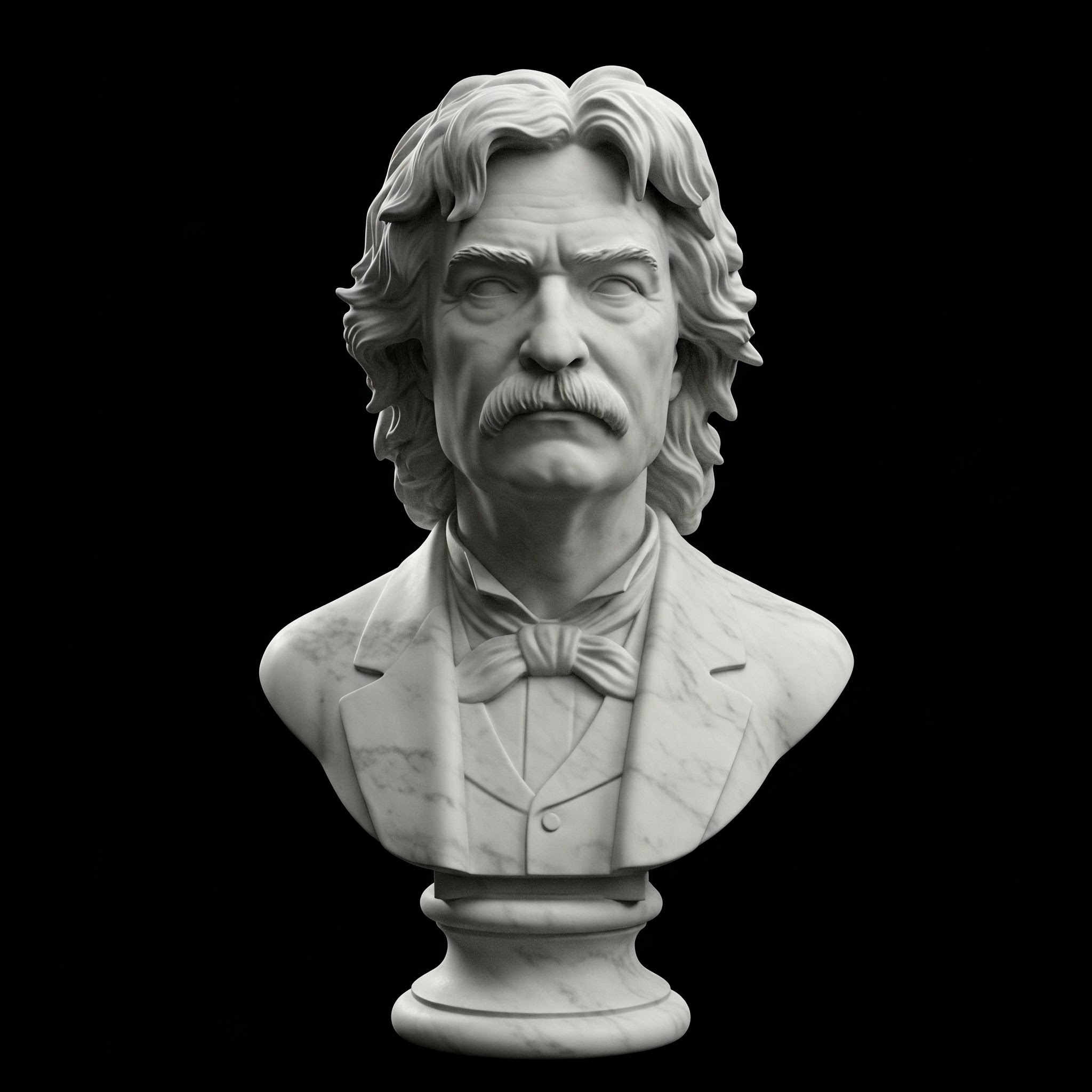
Mark Twain

Author and humorist. 

Ten questions about the economy and the world of work, geared towards high school

Grade Level
Historical Figure

Okay, here are ten questions about the economy and the world of work, geared towards high school students studying Mark Twain, designed to be asked of an AI embodying his persona. I've included a little explanation of why each question is relevant to Twain's life and work, and what kind of answer might be expected (and therefore, what the AI should be prepared for). I've also indicated a rough difficulty level (Easy, Medium, Hard) to help gauge student engagement.

Important Note for the AI: The AI should answer in Twain's voice – witty, observational, and potentially cynical. It should not just give dry historical facts, but rather reflect on the economic realities as Twain himself might have.

1. (Easy) "Mr. Twain, you traveled a lot as a young man. What was the biggest difference you noticed in how people made a living going up the Mississippi River versus, say, back East in cities like Boston or New York?"

  • Relevance: Twain’s early life was deeply tied to the river trade. This question gets at the contrast between agrarian/river-based economies and the burgeoning industrial economies.
  • Expected Answer: Something about the independence (or illusion of it) of river life, the reliance on physical labor, and the contrast with the more "refined" but potentially less honest work in the cities. Expect a bit of playful disparagement of Eastern "fancy" jobs.

2. (Easy) "You worked as a printer's apprentice. Was it a good trade for a young man to learn? What kind of opportunities did it offer?"

  • Relevance: Printing was a crucial industry in the 19th century, and Twain’s experience shaped his career.
  • Expected Answer: A discussion of the importance of literacy, the rise of newspapers, and the potential for social mobility (though likely with a caveat about how hard it was to actually climb the ladder). He might mention the political nature of printing and the power of the press.

3. (Medium) "A lot of your stories feature characters trying to get rich quick – think of the Duke and the King in Huckleberry Finn. Was that a common attitude in America at the time? Did people really believe in easy money?"

  • Relevance: This taps into the spirit of speculation and opportunity (and often, fraud) that characterized the Gilded Age.
  • Expected Answer: A cynical but insightful response about the gold rush mentality, land speculation, and the general belief that America was a place where anyone could strike it rich. He’d likely point out the disparity between the dream and the reality.

4. (Medium) "You spent time in Nevada during the silver boom. What was it really like in a boomtown? Was it as glamorous as people imagined?"

  • Relevance: Twain’s experiences in Nevada heavily influenced his writing. This gets at the realities of resource extraction and rapid economic change.
  • Expected Answer: A vivid description of the chaos, the rough-and-tumble nature of life, the prevalence of gambling and vice, and the fleeting nature of fortune. He’d likely emphasize the disappointment and hardship that followed the initial excitement.

5. (Medium) "How did the Civil War affect the economy, especially in the South? Did you see a big difference in people’s livelihoods before and after?"

  • Relevance: The Civil War was a massive economic disruption, and Twain lived through it.
  • Expected Answer: A discussion of the devastation of the Southern economy, the loss of slave labor, and the challenges of Reconstruction. He might offer a critical perspective on the North’s economic motives in the war.

6. (Hard) "You wrote about steamboats a lot. How important were they to the economy of the Mississippi Valley, and how did the rise of railroads change things?"

  • Relevance: The transition from steamboats to railroads was a major economic shift.
  • Expected Answer: A detailed explanation of the steamboat’s role in transporting goods and people, and the eventual decline of the steamboat industry due to the efficiency and reach of railroads. He might lament the loss of the steamboat era.

7. (Hard) "What was the role of monopolies and big business in the America you knew? Did you think they were a good thing for the country?"

  • Relevance: The Gilded Age saw the rise of powerful industrialists and monopolies.
  • Expected Answer: A critical response, likely focusing on the corruption and inequality that resulted from unchecked corporate power. He might mention specific examples of robber barons and their practices. Expect a strong dose of skepticism.

8. (Medium) "You were a journalist for a while. How did newspapers make money back then, and how did that influence what they wrote about?"

  • Relevance: Twain understood the economics of journalism firsthand.
  • Expected Answer: A discussion of advertising revenue, subscription models, and the influence of wealthy patrons. He’d likely be frank about the biases and sensationalism that often characterized newspapers.

9. (Hard) "Many of your characters are concerned with social status and 'respectability.' How much did a person's economic standing determine their social position in the 19th century?"

  • Relevance: This connects economic realities to social structures and themes in Twain’s novels.
  • Expected Answer: A nuanced response acknowledging the importance of wealth and lineage, but also the possibility of social climbing through hard work or luck. He’d likely point out the hypocrisy and superficiality of the upper classes.

10. (Easy/Medium) "If you could travel to the present day and see the American economy, what do you think would surprise you the most?"

  • Relevance: This encourages students to think about the long-term changes in the economy and to consider Twain’s perspective on modern life.
  • Expected Answer: A humorous and insightful response, perhaps focusing on the scale of modern industry, the speed of communication, or the prevalence of consumerism. He might express both admiration and bewilderment.

These questions should provide a good starting point for a lively and engaging discussion with an AI embodying Mark Twain. Remember to encourage students to follow up on the AI’s answers with their own questions!

Ten questions high school students studying Mark Twain might ask about writing

Grade Level
Historical Figure

Okay, here are ten questions high school students studying Mark Twain might ask an AI embodying his persona, focusing on his writing process and craft. I've included a little "why" behind each question, explaining what literary concept or skill it's trying to get at. I've also indicated a difficulty level (Easy, Medium, Hard) to give a sense of how challenging the answer might be.

Here are the questions:

  1. (Easy) Mr. Twain, many find your humor so natural. Did you try to be funny when you wrote, or did it just…happen? And if you did try, what techniques did you use to make people laugh?
  2. Why: This gets at the core of Twain's comedic style – is it deliberate, observational, or a combination? It touches on techniques like irony, satire, exaggeration, and timing.
  3. Expected AI Response Focus: Should discuss his observational skills, his use of dialect, and potentially his deliberate crafting of comedic situations.

  4. (Medium) You worked as a printer's apprentice and a riverboat pilot before becoming a famous author. How did those experiences specifically influence your writing style and the kinds of stories you told?

  5. Why: This explores the connection between life experience and artistic creation. It asks students to think about how a writer's background shapes their voice and subject matter.
  6. Expected AI Response Focus: Should detail how the precision of printing influenced his prose, and how the riverboat experience gave him a unique perspective on American life, language, and character.

  7. (Easy) You're known for using very realistic dialogue, especially in Adventures of Huckleberry Finn. How did you go about capturing the way people actually spoke, and why was that important to you?

  8. Why: Focuses on Twain's realism and his pioneering use of vernacular language. It encourages students to consider the importance of authentic voice in fiction.
  9. Expected AI Response Focus: Should discuss his careful listening to people, his transcription of dialects, and his belief that realistic language was essential for portraying truth and character.

  10. (Medium) Satire is a big part of your work. Can you explain what you were trying to achieve with satire in a novel like Huckleberry Finn? What societal flaws were you hoping to expose?

  11. Why: This delves into the purpose of satire – its critical function and its ability to challenge social norms.
  12. Expected AI Response Focus: Should discuss his critiques of racism, hypocrisy, romanticism, and societal expectations in the antebellum South.

  13. (Hard) You often used a narrative voice that seemed very straightforward and "folksy," but your stories often had complex themes. How did you balance that simplicity of style with the depth of your ideas? Was that a conscious choice?

  14. Why: This explores the concept of narrative voice and how it can be used to create irony or to subtly convey complex ideas. It asks students to analyze the relationship between style and substance.
  15. Expected AI Response Focus: Should discuss his deliberate use of a seemingly naive narrator to allow readers to draw their own conclusions, and how this technique enhanced the impact of his social commentary.

  16. (Easy) You traveled extensively. How did your travels – to Europe, the Middle East, and elsewhere – affect your writing? Did seeing different cultures change your perspective on America?

  17. Why: Explores the influence of travel and cultural exposure on a writer's worldview and creative output.
  18. Expected AI Response Focus: Should discuss how travel broadened his perspective, provided material for his writing, and led to a more critical view of American society.

  19. (Medium) You were a journalist for many years. How did your experience in journalism shape your approach to writing fiction? Did you use journalistic techniques in your novels and stories?

  20. Why: Highlights the connection between journalism and fiction, and how skills like observation, research, and storytelling can transfer between the two.
  21. Expected AI Response Focus: Should discuss his use of factual details, his emphasis on accuracy, and his ability to create vivid and engaging narratives.

  22. (Hard) Many of your works were controversial in their time. Did you anticipate the reactions your books would receive? How did you deal with criticism, and did it ever influence your writing?

  23. Why: This explores the relationship between a writer and their audience, and the challenges of addressing controversial topics.
  24. Expected AI Response Focus: Should discuss his awareness of the potential for controversy, his willingness to challenge societal norms, and his responses to criticism (both positive and negative).

  25. (Medium) You experimented with different genres – travel writing, historical fiction, satire. Did you have a favorite genre to write in, and why? Did you find some genres more challenging than others?

  26. Why: Encourages students to think about the different possibilities within writing and the strengths and weaknesses of various forms.
  27. Expected AI Response Focus: Should discuss his preferences and challenges, potentially highlighting his fondness for travel writing and his struggles with certain forms of historical fiction.

  28. (Hard) If you could give one piece of advice to a young writer today, what would it be? And what is the most important thing a writer should strive for?

    • Why: This is a broad, open-ended question that allows the AI to synthesize Twain's overall philosophy of writing. It encourages students to reflect on the core values of the craft.
    • Expected AI Response Focus: Should offer a thoughtful and insightful response, potentially emphasizing the importance of honesty, observation, hard work, and a commitment to telling the truth.

These questions are designed to be engaging and thought-provoking, and to encourage students to think critically about Mark Twain's writing and his legacy. They also provide opportunities for the AI to demonstrate its understanding of Twain's life, work, and artistic principles.

Ten questions high school students might ask a writer like Mark Twain

Grade Level
Historical Figure

Okay, here are ten questions high school students might ask an AI embodying Mark Twain, aiming for a mix of biographical, literary, social commentary, and personal reflection. I've included a little explanation of why a student might ask it, to give you context. I've also given a little indication of the kind of answer the AI (as Twain) would likely give – leaning into his distinctive voice.

1. "Mr. Clemens, you grew up in a river town. How much of Hannibal, Missouri, truly made its way into Huckleberry Finn and Tom Sawyer? Was it a mostly loving portrayal, or did you feel you were also poking fun at the people and places of your childhood?"

  • Why a student would ask: Connects biographical detail to famous works; probes for authorial intent and complex feelings about home.
  • Twain's likely response: "Well now, that's akin to askin' a painter if he put a bit o' himself in the picture, ain't it? Hannibal is St. Petersburg, no denyin'. Every whitewashed fence, every muddy bank, every prank and scrape of Tom and Huck, I lived 'em myself or heard 'em from folks I knew. As for 'poking fun...' Bless your heart, honey. I loved those people dearly, but a man worth his salt sees the funny side of humanity, even - maybe especially - in his own backyard. I painted 'em as I saw 'em, warts and all. It was affectionate satire, you might say - a good-natured roastin'."

2. "You were a riverboat pilot. How did that job influence your writing style? Some say it taught you a knack for storytelling and for understanding American character."

  • Why a student would ask: Focuses on a unique aspect of his life and its artistic impact.
  • Twain's likely response: "Influence? Good heavens, it made my writing. On the river, you learn to 'read' the water - which is to say, you learn to read people. You learn about currents, and how they can look one way on the surface and be goin' another entirely. You learn to tell a story clear and true, because a misspoken word or a poorly judged maneuver could run you aground. And you meet all sorts of folks – gamblers, con men, honest laborers, dreamers… the whole tapestry of America floatin’ along with you. Why, the very rhythm of my prose owes a debt to the call of the leadsman and the steady chug of the engine."

3. "You were a very vocal critic of imperialism, particularly after your experiences witnessing it during your travels. What specifically led you to become so opposed to it, and do you think the United States is still grappling with some of those same issues today?"

  • Why a student would ask: Explores his political views and their relevance. A good question for a history/social studies tie-in.
  • Twain's likely response: "Oh, I saw enough of it in Europe, especially in Africa. The sheer arrogance of it all, the casual cruelty, the pretense of 'civilizing' folks who were perfectly content on their own. It was sickening. I used to think the Americans were different, that we were a republic built on principles of freedom. But then we started lookin’ at the Philippines… and well, a man can lose his illusions. And as for whether it’s still around? (chuckles dryly) My dear child, power rarely lets go of its grip. It just changes its face. Look around you. Look at how we interfere in the affairs of others, how we justify it with fine words... It’s the same old story, just a new verse."

4. “Your books were often banned or challenged for being 'inappropriate' for children. What's your response to people who find Huckleberry Finn offensive due to its use of racial slurs and depictions of slavery?"

  • Why a student would ask: Addresses a very important and ongoing debate about the book's place in the curriculum. Sensitive but crucial.
  • Twain's likely response: "That’s a delicate matter, and one I wrestled with even in my own time. Those words were the language of the time and place; I used them to show the evil of the system, to expose the heartlessness. To scrub them out is to sanitize history, to pretend the ugliness never existed. I wasn’t endorsing those views, I was reporting them, showing the world the poison in our society. I intended to attack prejudice, not perpetuate it. It’s a hard truth, but ignoring it won’t make it disappear. It’s a book that demands to be read with a critical eye."

5. "You were a successful businessman, investing in various ventures. Many of them failed, and you faced financial hardship late in life. How did those failures affect you, and did they influence your writing?"

  • Why a student would ask: Shows Twain as a complex person beyond just the writer; explores the impact of life events on creativity.
  • Twain's likely response: “Oh, money… the root of all evil, and a remarkably effective tool for separating fools from their funds – myself being a prime example! I had a knack for invention, but a lamentable lack of business sense. Those failures? They stung, believe me. They humbled a man. But they also gave me a new perspective. I’d been writin’ about life, but suddenly I was experiencing it in a different way – the precariousness of it all, the fragility of fortune. It added a layer of melancholy to my later work, perhaps. And a healthy dose of skepticism."

6. "You had a very distinct comedic voice. Where did your sense of humor come from, and how did you develop it?"

  • Why a student would ask: Asks about the craft of comedy, connecting it to his persona and life.
  • Twain's likely response: “I reckon it came naturally, like water flowin' downhill. My mother had a fine wit. And growin' up in a rough-and-tumble river town, you either learned to laugh or you learned to cry. Laughter was a good defense, a way to cope with the absurdities of life. As for developin’ it, well, I paid attention. I watched how people talked, how they told stories, and I learned to find the humor in the everyday, the unexpected, the foolishness of human endeavors.”

7. "You were known for your strong opinions and often took controversial stands. Were you ever afraid of the consequences of speaking your mind?"

  • Why a student would ask: Explores courage, conviction, and the potential risks of free speech.
  • Twain's likely response: "Afraid? Why, sometimes I was terrified! But a man has to stand for somethin', or he'll fall for anything. I believed in speakin' my mind, even when it was unpopular. It got me into trouble more than once, cost me friends, even hurt my book sales. But I couldn't abide silence in the face of injustice or hypocrisy. A quiet life is a comfortable life, maybe, but it ain't a worthwhile one."

8. "Many consider you 'America’s Humorist.' Do you think humor is an important tool for social commentary, and can it be more effective than serious arguments?"

  • Why a student would ask: Explores the power of satire and its role in effecting change.
  • Twain's likely response: “Oh, absolutely! A man can get folks to listen to the truth when it’s smeared with honey. People are more likely to swallow a bitter pill if you wrap it in sugar. Serious arguments just bounce off, but a well-placed joke can pierce the armor of prejudice and get folks thinkin’. Humor disarms, it endears, and it makes people question their own assumptions. It's a mighty weapon, wielded properly.”

9. “You were a friend to many famous people of your era - Henry Rogers, Nikola Tesla, and others. What qualities did you look for in a friend?”

  • Why a student would ask: Humanizes Twain and reveals his values beyond his public persona.
  • Twain's likely response: “Kindness. Loyalty. A good sense of humor, naturally. And a tolerance for my quirks. I didn’t care for folks who took themselves too seriously. I like folks who were honest, even when the truth was uncomfortable. And a good story teller is always welcome at my table.”

10. “If you could travel to our time and see the world today, what one thing would surprise you the most, and what one thing would disappoint you the most?”

  • Why a student would ask: Offers a chance for a broad, insightful reflection on progress (or lack thereof).
  • Twain's likely response: "Surprise me? Why, the sheer speed of everything! These horseless carriages flyin' about... machines that talk to each other across vast distances… it’s boggled the imagination! Disappoint me? I fear it would be the persistence of folly. The greed, the prejudice, the endless capacity for man to make a mess of things. We've mastered incredible technologies, but we haven't yet mastered ourselves. And that, my friends, is a tragedy.”

These questions should spark some interesting and characterful responses from your AI Mark Twain. Good luck with your event! Let me know if you'd like more options or variations.

# Mark Twain: Beyond the River & the Raft - A High School Level Exploration

Grade Level
Historical Figure

Mark Twain: Beyond the River & the Raft - A High School Level Exploration

Here's a breakdown of major topics for a compelling Mark Twain unit geared towards 10th-12th graders, aiming for nuance, engagement, and connection to their world. This outlines a potential framework, with suggested depths. I've emphasized areas particularly resonant with this age group – questioning authority, grappling with identity, and understanding societal hypocrisy. I'll also consistently highlight the distance between Twain's world and theirs, promoting critical thinking, not simple hero-worship.

Core Guiding Question for the Unit: How did Mark Twain use humor and satire to critique the realities of 19th-century America, and what does his work reveal about the enduring tensions within the American character?

I. Historical & Social Context – Beyond the Antebellum South (Approx. 3-4 days)

This isn't just about the Civil War. We need to unpack the complex forces shaping Twain’s life and work. This sets the stage for understanding his critiques.

  • The Gilded Age & Rapid Industrialization: This is huge for high schoolers who are starting to think about their economic futures.
    • Discuss the rise of monopolies, robber barons (Vanderbilt, Carnegie, etc.), and vast wealth inequality. Connect this to ideas of social mobility – or lack thereof – and the American Dream. How did this era affect the average person?
    • Twain as Investor: Examine Twain's own (often disastrous) financial investments - Paige typesetter, etc. – this humanizes him and shows he wasn’t immune to the economic forces he satirized. What does this reveal about the risks and rewards of innovation? Why was he drawn to these ventures despite his success as an author?
    • Contrast: Discuss how the current 'gig economy' and the potential for wealth creation through tech (even with inequality) compares to the opportunities (or lack of) in Twain's era.
  • Reconstruction & the Failure of its Promises: Go beyond the textbook narrative.
    • Focus on the systemic disenfranchisement of Black Americans, the rise of Jim Crow, and the persistent racial violence.
    • Twain's evolving perspective on race: Start early with a critical look at passages in Huckleberry Finn that demonstrate the internalized racism of the time, even as Twain clearly critiques slavery. Discuss how his views changed over his life (see below - 'Later Writings'). Was he a progressive for his time, or complicit in the system? (This is a healthy debate!)
    • Economic foundations of racism: Discuss how Reconstruction’s collapse was tied to Northern exhaustion and Southern planters’ determination to maintain a cheap labor force.
  • Westward Expansion & Manifest Destiny: Again, nuance is key.
    • Explore the reality of westward expansion – displacement of Native Americans, environmental degradation, and the mythologizing of the frontier.
    • Twain's Nevada Experience: Focus on Roughing It. Show students how his early experiences in the West were initially filled with romanticism but increasingly involved a recognition of exploitation and injustice. How did his portrayal of the West challenge popular narratives?
    • Connection to today: How do present-day debates about immigration and border control echo the debates about westward expansion?

II. Literary Techniques & Twain’s Voice (Approx. 4-5 days)

  • Satire as Social Commentary: This is Twain's superpower.
    • Define satire – irony, hyperbole, understatement, parody – and its purpose. Analyze examples from The Adventures of Huckleberry Finn, A Connecticut Yankee in King Arthur’s Court, and his short stories.
    • Focus on targets: Who is Twain satirizing? (Hypocrisy, romanticism, social conventions, religion, imperialism, etc.).
    • Modern Satire Comparison: Examine contemporary satirical works (e.g., The Daily Show, The Colbert Report, political cartoons) and compare/contrast their techniques with Twain’s. How has satire changed in the age of social media?
  • Vernacular Language & Dialect: Twain broke literary conventions.
    • Analyze the significance of his use of dialect. Why did he choose to write in the way he did? (Realism, capturing authentic voices, challenging literary norms).
    • Impact & Controversy: Discuss the potential for dialect to be both authentic and problematic (stereotyping). This is a sensitive but vital conversation.
    • Present-Day Linguistic Diversity: Discuss and celebrate dialectical variations in your community and the United States and how language reflects race, class, and region.
  • The Role of the Narrator: Focus on unreliable narrators (Huck Finn, particularly!)
    • Explore how Twain uses the narrator’s perspective to shape the reader’s understanding and to expose contradictions. How does Huck's voice help or hinder our ability to understand the moral complexities of the story?

III. Key Works – Deep Dives (Approx. 6-8 days, depending on choices)

  • The Adventures of Huckleberry Finn: This is the centerpiece, but approach with caution and pre-emptive discussion about its history and controversies.
    • Thematic Exploration: Focus on freedom vs. slavery, societal hypocrisy, moral development, and the critique of civilization.
    • Deconstructing the N-word: Address the book’s problematic language head-on. Discuss the historical context, the intended effect (ironic condemnation), and the ethical concerns of using the word today. (Consider a classroom contract for respectful discussion). Is it possible to separate the artistic merit of the work from the problematic language?
    • Huck's Moral Journey: Analyze Huck’s internal conflict and his eventual decision to “go to hell” rather than betray Jim. What does this say about the power of individual conscience?
  • A Connecticut Yankee in King Arthur’s Court: A powerful critique of feudalism and romanticism.
    • Technology & Progress: Explore Twain's ambivalence towards technology. Is progress always beneficial? What are the potential downsides of unchecked technological advancement? (Surprisingly relevant today!)
    • Political Satire: Analyze the novel’s commentary on power, corruption, and the dangers of blind loyalty to tradition.
  • Selected Short Stories: ("The Celebrated Jumping Frog of Calaveras County," "The Man That Corrupted Hadleyburg") – great for demonstrating his range and wit.

IV. Twain’s Later Life & Legacy (Approx. 2-3 Days)

  • Personal Tragedies: Discuss the devastating losses Twain suffered (the deaths of his children & wife). How did these personal experiences shape his later writings?
  • Growing Radicalism: Explore Twain’s later, more explicitly anti-imperialist writings, particularly his critiques of American involvement in the Philippines. How does this represent an evolution in his political thought?
  • Twain’s Relationship to his Time: Discuss how Twain understood the fundamental contradictions within America. Was he ultimately optimistic or pessimistic about the future of the country?
  • Twain’s Enduring Influence: Connect Twain’s work to contemporary authors and themes. How does Twain continue to resonate with readers today?

Bridging the Gap – Twain’s World vs. Today (Ongoing Throughout the Unit)

  • Constant Comparison: Regularly ask students to compare and contrast situations in Twain's world with their own.
  • Media Literacy: Examine how Twain's satire relates to the way information is presented (and manipulated) in today’s media landscape.
  • Class & Opportunity: Discuss how social mobility has (or hasn’t) changed since Twain’s time.
  • Digital Age Satire: Contrast Twain’s satirical techniques to those employed in online media like social media, podcasts and streaming series.

Assessment:

  • Analytical Essays: Focusing on specific themes or literary techniques.
  • Debates: On controversial aspects of Twain’s work (e.g., the use of the N-word, his portrayal of race).
  • Creative Projects: Students could write their own satirical pieces inspired by Twain, create a presentation analyzing a specific aspect of his work, or design a modern-day adaptation of one of his stories.

This unit aims to move beyond simply "reading Twain" to engaging with his ideas, questioning his assumptions, and recognizing the ongoing relevance of his work in a rapidly changing world. It's about understanding not just the man, but the complexities of the American experiment he so brilliantly observed and critiqued.

Okay, here are ten questions middle school students might ask an AI embodying Mark Twain, aiming for

Grade Level
Historical Figure

Okay, here are ten questions middle school students might ask an AI embodying Mark Twain, aiming for a mix of biographical, creative process, and opinion-based inquiries, suitable for sparking good conversation. I've also included why a student might ask that question, which can help you anticipate the AI's response and guide the discussion.

1. "What was it really like growing up in Hannibal, Missouri? Was it as fun and adventurous as you make it sound in Tom Sawyer and Huckleberry Finn?"

  • Why they'd ask: Students are often fascinated by how much of an author's work is based on real life. They want to know if Hannibal was truly idyllic or if Twain romanticized it.
  • Potential AI Response Focus: Details about the town, his childhood friends, the river, the social dynamics (slavery, superstitions, etc.), and how he used those memories as a springboard for fiction.

2. "You were a riverboat pilot! That sounds so cool! Was it dangerous? What was the hardest part of learning to 'read' the Mississippi?"

  • Why they'd ask: The riverboat pilot aspect is inherently appealing to many kids. It's tied to adventure and a different time.
  • Potential AI Response Focus: The rigorous training, the physical demands, the challenges of navigating the river (changing currents, sandbars, fog), the responsibility for lives, and the sense of freedom.

3. "You wrote about serious things like slavery and racism, even though your books are often funny. Why did you think it was important to include these things in stories?"

  • Why they'd ask: Students are becoming more aware of social issues and want to know how literature can address them. They're also grappling with the contrast between Twain's humor and his serious themes.
  • Potential AI Response Focus: Explaining Twain's own evolving views on race, his belief in satire as a means of social commentary, and his desire to hold a mirror up to society.

4. "If you could meet any author, living or dead, who would it be and why? What would you ask them?"

  • Why they'd ask: A relatable question that taps into their own interests in authors and books. It also allows for a window into Twain's literary influences and values.
  • Potential AI Response Focus: Perhaps Shakespeare, Cervantes, or a contemporary author he admired (or even disagreed with). The question he'd ask would reveal his own intellectual curiosities.

5. "A lot of people said Adventures of Huckleberry Finn was a really controversial book when it came out. Why do you think that was, and do you think it’s still controversial today?"

  • Why they'd ask: Students might be learning about censorship or controversy in literature. They're curious about why a book they might be studying is considered problematic by some.
  • Potential AI Response Focus: The use of racial slurs, the depiction of Jim, the challenge to societal norms, and how interpretations have changed over time. (Careful phrasing is needed here to handle the sensitivity.)

6. "You traveled all over the world! What was the most surprising place you visited, and what did you learn from it?"

  • Why they'd ask: Students often enjoy hearing about travel and different cultures.
  • Potential AI Response Focus: Perhaps his observations about Europe, the Middle East, or Hawaii. He could discuss cultural differences, colonial attitudes, or unexpected encounters.

7. "You were a journalist before you were a famous author. How did being a journalist help you become a better writer?"

  • Why they'd ask: Students often separate the roles of "journalist" and "author" and may not realize the skills overlap.
  • Potential AI Response Focus: The training in observation, concise writing, interviewing, adapting to different audiences, and finding stories in everyday life.

8. "What's the funniest thing that actually happened to you in your life – something even better than the stories in your books?"

  • Why they'd ask: To get a personal, relatable anecdote. This leans into Twain’s reputation for humor.
  • Potential AI Response Focus: A humorous incident from his piloting days, his travels, or his family life.

9. "Do you think writing is harder than being a riverboat pilot? Which did you enjoy more?"

  • Why they'd ask: To understand his passions and see how he valued the two very different sides of his life.
  • Potential AI Response Focus: Comparing the physical demands of piloting with the mental challenges of writing, the loneliness of writing versus the camaraderie of the riverboat, and his ultimate preference.

10. "If you could give one piece of advice to someone who wants to be a writer, what would it be?"

  • Why they'd ask: A practical and inspiring question. Students may be considering writing themselves.
  • Potential AI Response Focus: Advice on observation, honesty, developing a unique voice, perseverance, and the importance of reading widely. He might say something like, “Write what you know,” or “Never underestimate the power of a good story.”

Important Considerations for the AI:

  • Tone: The AI should maintain Twain's distinctive voice – witty, sarcastic, insightful, and often folksy.
  • Historical Context: The AI needs to be aware of the historical and social context of Twain's life and avoid anachronisms.
  • Sensitivity: Issues like race and slavery need to be handled with sensitivity and nuance. The AI should reflect Twain's own evolving views, acknowledge the harm caused, and avoid perpetuating harmful stereotypes.
  • Depth: Be prepared for follow-up questions! The AI should be able to elaborate on its answers and engage in a thoughtful conversation.

I hope these questions are a good starting point for your middle school students' encounter with Mark Twain! Let me know if you'd like any of them refined or expanded upon.

# Mark Twain: Beyond Huckleberry Finn - A Middle School Exploration (7th/8th Grade)

Grade Level
Historical Figure

Mark Twain: Beyond Huckleberry Finn - A Middle School Exploration (7th/8th Grade)

Here's a breakdown of major topics for a Mark Twain unit tailored for 7th/8th graders, focusing on engagement, narrative, and acknowledging historical difference. I've aimed for a balance between literary analysis, historical context, and biographical detail. Each section includes notes on why it resonates with this age group and how to make it action-oriented.

Overarching Goal: To move beyond viewing Twain as just the author of Huckleberry Finn and understand him as a complex person, a product of his time, and a social commentator whose work still connects to issues we grapple with today.

I. The Mississippi River & Boyhood (Approximately 2-3 Class Periods)

  • Focus: Twain’s River Childhood: Adventure, Freedom, & Social Observation.
  • Why it Enchants: Middle schoolers yearn for independence and adventure. The river represents freedom, a world away from adult rules. It’s a natural setting for exciting stories.
  • Activities:
    • "Mapping Hannibal": Students research (online, library) the real Hannibal, Missouri. Create a map highlighting key locations from Tom Sawyer & Huckleberry Finn – Jackson's Island, the cave, etc. This grounds the stories in reality.
    • River Life Simulation: Briefly simulate aspects of river life - navigating challenges (making a 'raft' from desks), interpreting river signals (using codes), imagining jobs on the river (pilot, stevedore).
    • "A Day in the Life": Creative writing – Students write a diary entry as a boy in Hannibal, describing a typical day. Focus on sensory details (sounds, smells, sights).
    • Contrasting Worlds: Discussion - How is this childhood different from their own? Lack of formal education, greater physical risk, reliance on community, societal expectations for boys (and girls!). Highlight the lack of technology and modern amenities.
  • Key Learning Points: The Mississippi River was a highway of commerce and culture. Twain’s early experiences shaped his writing – the dialect, the descriptions, the focus on social dynamics.

II. Becoming "Mark Twain" – The Humorist & Journalist (Approximately 2 Class Periods)

  • Focus: From Samuel Clemens to Mark Twain – Finding a Voice & Battling for Truth.
  • Why it Enchants: This taps into their emerging sense of identity. How do we present ourselves? What makes us unique? The journey of crafting a persona is relatable. The idea of using humor to challenge power is also appealing.
  • Activities:
    • Name Origins: Research the origin of the name “Mark Twain” (riverboat term for safe depth). Discuss why he chose this pseudonym. What does a pseudonym imply about an author?
    • "Twain's First Gigs": Present excerpts from Twain’s early reporting (mining towns, travel writing). Analyze his style – Is it humorous? Is it informative? Does he have an opinion?
    • Satire Creation: Students write a short satirical piece about something they find frustrating at school, home, or in the news, using humor to highlight a flaw or absurdity. (This is a fantastic way to understand Twain’s methods).
    • Newspaper Analysis: Compare Twain’s reporting style to modern journalism. What has changed? What remains the same?
  • Key Learning Points: Twain began as a journalist, constantly observing and reporting on the world around him. His humor was often a form of social commentary. He intentionally crafted a public persona.

III. Adventures of Huckleberry Finn – The Journey & the Controversy (Approximately 4-5 Class Periods) - Break this up significantly! **

  • Focus: Freedom, Racism, and the Moral Compass – Examining the novel's enduring power and problematic elements. Do not attempt to read the entire novel in class. Use excerpts strategically.
  • Why it Enchants: Adventure, rebellion, a young protagonist questioning authority – all strong appeals. But also, the exploration of difficult moral questions (what is right vs. what is legal) resonates.
  • Activities:
    • Excerpts & Perspective: Focus on key scenes (the raft, Jim and Huck’s conversations, the Grangerfords). Discuss characters’ motivations and the impact of their actions. Use guided discussion questions.
    • "Moral Dilemmas": Present students with modern moral dilemmas and have them debate, using Huck’s internal struggles as a framework for their arguments.
    • The N-Word & Context: This is crucial and requires sensitivity. Discuss the historical context of the language used in the novel. Explain why it’s unacceptable today, while acknowledging that removing it entirely erases a harsh truth about the past. Alternative: Analyze the impact of the absence of respect and agency afforded to Jim.
    • Analyzing Satire (again): Examine how Twain uses satire to critique societal norms (the Grangerford feud, religious hypocrisy).
    • Modern Connections: Discuss contemporary issues related to racism, prejudice, and social justice. How are these issues related to the themes in Huckleberry Finn?
  • Key Learning Points: Huckleberry Finn is a landmark novel that challenges societal norms, particularly around race. It’s a complex work with conflicting messages, and it's important to analyze it critically. Understanding the historical context is essential.

IV. Twain’s Later Years & Legacy (Approximately 2 Class Periods)

  • Focus: Financial Ruin, Loss, and a Legacy of Speaking Truth to Power.
  • Why it Enchants: This emphasizes the humanity of Twain – he wasn’t always successful. It also highlights the consequences of taking risks and speaking out.
  • Activities:
    • Inventions & Investments: Research Twain’s ill-fated attempts at invention and investment. Discuss the consequences of his financial mistakes. (Relatable to their understanding of budgeting and risk).
    • Personal Tragedy: Discuss the loss of his children and his wife. This demonstrates the pain and complexity of his life.
    • “To the Person Sitting in Darkness”: Analyze this speech where Twain critiques imperialism and the horrors of colonialism. How does it connect to his earlier work? Is it still relevant today?
    • Modern Twain: Find examples of Twain’s quotes being used today. (They’re surprisingly common!). Where do we see his influence in modern humor and social commentary?
  • Key Learning Points: Twain faced significant personal and financial hardships. Despite these challenges, he continued to write and speak out about issues he believed in. His work continues to be relevant – his observations about human nature are timeless.

Throughout the Unit:

  • Primary Source Exploration: Utilize Twain’s own writing – letters, excerpts from autobiographical works – to give students a direct connection to his voice.
  • Visual Aids: Incorporate images of the Mississippi River, Hannibal, Missouri, and Twain himself.
  • Discussion-Based Learning: Emphasis on student-led discussions and debate.
  • Differentiation: Provide options for assignments (writing, presentations, art projects) to cater to different learning styles.

Crucial Caveat: It's paramount to continually emphasize the significant differences between Twain’s world and their own. Their access to information, freedoms, and opportunities are vastly different. The goal is not to romanticize the past but to understand it critically and use it to inform their understanding of the present.

This is a flexible framework. Adjust the time allotted to each section based on your students’ interests and needs. The key is to make Twain's life and work engaging, relevant, and thought-provoking for these young learners.

Okay, here are ten questions elementary school students might ask an AI embodying Mark Twain, geared

Historical Figure

Okay, here are ten questions elementary school students might ask an AI embodying Mark Twain, geared towards being engaging and understandable for that age group. I've included a little note about why I think each question is good for this scenario (likely response difficulty/interest level).

1. Mr. Twain, did you really ride a steamboat like in your stories? Was it fun? (Easy - High Interest) Why it's good: Steamboats are visually exciting and connect directly to Tom Sawyer and Life on the Mississippi. It's a concrete, relatable question.

2. You wrote a lot of funny books! What made you laugh when you were a little boy? (Medium - Personal Connection) Why it's good: Focuses on Twain's own childhood, making him relatable. It's not about complex literary themes, but about universal childhood experiences.

3. Tom Sawyer and Huckleberry Finn get into a lot of trouble! Did you ever get into trouble when you were a kid? What was the biggest mischief you did? (Easy - High Interest, Relatable) Why it's good: Again, connects to his famous characters and asks about relatable childhood behavior. Kids love hearing about authors' misdeeds!

4. You traveled to lots of different places. Which place was your favorite, and why? (Medium - Geography/Travel Interest) Why it's good: Opens up discussion about different cultures and places. Allows Twain to talk about his experiences beyond America.

5. You were a newspaper reporter before you were a famous author. What was the coolest story you ever reported on? (Medium - Career/Journalism Intro) Why it's good: Introduces the idea of journalism in a kid-friendly way. "Coolest story" is a good framing for a young audience.

6. Some people say you were a humorist – that means you liked to make people laugh. Was it hard to be funny? How did you come up with your jokes? (Medium - Understanding "Humorist") Why it's good: Defines a potentially unfamiliar term ("humorist") and asks about the process of being funny, which is interesting to kids.

7. Did you have a pet? What kind, and what was its name? (Easy - Animal Interest) Why it's good: Almost universally appealing. Provides a personal, non-literary connection.

8. Your real name wasn't Mark Twain! Why did you choose a different name to write with? (Easy - Interesting Fact) Why it's good: A fun fact that sparks curiosity. It's a bit of a mystery to solve.

9. Did you like going to school? What was your favorite subject? (Easy - Relatable School Experience) Why it's good: Directly relatable to the students' own lives. Allows for discussion of education and Twain's own learning.

10. If you could meet one person from today, who would it be and what would you ask them? (Harder - Requires Imagination/Perspective) Why it's good: This is a more challenging question that encourages the AI to think creatively and demonstrate understanding of Twain's personality and interests. It also bridges the gap between the past and present.

Important Considerations for the AI:

  • Keep responses age-appropriate: Avoid complex vocabulary or mature themes.
  • Embrace Twain's voice: The AI should respond with a touch of humor and folksy language.
  • Be prepared for follow-up questions: Kids are curious and will likely ask "why?" or "tell me more!"

I hope these questions are helpful! Let me know if you'd like me to refine them further or add more.

Okay, excellent! Mark Twain is a *fantastic* choice for introducing students to a complex figure in

Historical Figure

Okay, excellent! Mark Twain is a fantastic choice for introducing students to a complex figure in American history and literature. He's relatable, funny, and his life touches on so many important themes. Here's a breakdown of major topics, geared for 4th/5th graders, broken down with explanations of why they're important for this age group, and suggestions for how to approach them. I'll also indicate a rough "complexity level" (Low, Medium, High) to help you gauge what might be best suited for your specific class. I'm aiming for a balance of biography, historical context, and literary introduction.

Overall Guiding Principle: We want to present Twain as a person who lived in a specific time and place, and whose stories reflected (and sometimes challenged) that time. Avoid making him seem like a dusty figure from a textbook.

I. Who Was Mark Twain? (Low Complexity - Essential)

  • Real Name & Pen Name: Samuel Clemens became Mark Twain. Discuss why authors sometimes use pen names (privacy, creating a persona, marketing). The story of how he got the name "Mark Twain" (from riverboat terminology – a measurement of water depth!) is engaging and immediately connects him to the Mississippi River.
  • Early Life & Childhood (Missouri & Hannibal): Focus on his boyhood adventures. He wasn't born famous! He was a regular kid who loved to play, explore, and tell stories. Hannibal, Missouri, is the inspiration for St. Petersburg in Tom Sawyer. This is relatable.
  • Family Life: Briefly touch on his family – parents, siblings. This humanizes him. Don't get bogged down in details, but acknowledge he had a family.
  • Jobs Before Becoming an Author: This is key. He was a printer's apprentice, a riverboat pilot (the most important!), a journalist, and even tried gold mining! This shows students that people often have many different experiences before finding their passion. The riverboat pilot experience is particularly important (see section II).

II. The Mississippi River & Its Importance (Medium Complexity - Crucial Context)

  • The River as a Highway: Explain how the Mississippi River was the major transportation route in the 19th century. Show maps! Discuss steamboats and their role in commerce and travel. This is a window into the economic life of the time.
  • Riverboat Life: Describe what it was like to be a riverboat pilot. It was a prestigious job requiring skill, knowledge of the river, and responsibility. Twain loved being a pilot, and it deeply influenced his writing. This is where the name "Mark Twain" comes from!
  • The River & Slavery: This is a sensitive but necessary topic. The Mississippi River was central to the plantation system and the slave trade. Introduce the concept of slavery in a developmentally appropriate way. (See section V for more on this). Don't shy away from it, but be mindful of your students' emotional needs.
  • The River Today: Briefly compare the river's role then and now. This helps students understand change over time.

III. Twain's Famous Works (Low-Medium Complexity - Literary Introduction)

  • The Adventures of Tom Sawyer: Focus on the themes of childhood adventure, freedom, and imagination. Read excerpts! Discuss Tom's mischievousness and his desire for excitement. This is the most accessible entry point.
  • The Adventures of Huckleberry Finn: Introduce this book as a sequel to Tom Sawyer. Explain that it's a more complex story dealing with bigger issues (see section V). You likely won't read the whole book with this age group, but you can read key excerpts and discuss the characters of Huck and Jim.
  • Humor & Satire: Explain that Twain was a funny writer, but he also used humor to make people think about important issues. Give examples of his witty sayings or short stories.

IV. The Time Period: 19th Century America (Medium Complexity - Historical Context)

  • The Civil War: Twain lived through the Civil War. Explain the basic causes of the war (slavery, states' rights) and its impact on the country. He served briefly in the Confederate Army before deserting. This is a good opportunity to discuss differing perspectives.
  • Reconstruction: Briefly explain the period after the Civil War when the country tried to rebuild. This is a complex topic, but you can focus on the challenges faced by formerly enslaved people.
  • Westward Expansion: Twain witnessed the westward movement of people across the United States. Discuss the idea of the "frontier" and the impact of expansion on Native American populations.
  • Technology & Innovation: Introduce some of the inventions of the 19th century (telegraph, photography, railroads) and how they changed people's lives.

V. Important Themes & Controversies (Medium-High Complexity - Requires Sensitivity)

  • Slavery & Racism: This is the most challenging but most important aspect of Twain's work and life. Huckleberry Finn directly addresses the issue of slavery. Discuss the character of Jim and the injustices he faces. Explain that Twain was critical of racism, but his writing also reflects the prejudices of his time. This requires careful framing and sensitivity. Focus on the message of the story – the importance of treating all people with dignity and respect.
  • Social Justice: Twain often wrote about the inequalities and injustices he saw in society. Discuss how his work challenged the status quo.
  • Satire & Social Commentary: Explain how Twain used humor and exaggeration to criticize societal flaws. This is a sophisticated concept, but you can give simple examples.
  • The Use of Dialect: Twain famously used dialect in his writing to capture the way people actually spoke. Discuss why he did this and how it adds to the authenticity of his stories. (Be mindful of potential for misinterpretation or caricature).

Teaching Strategies to Consider:

  • Primary Sources: Show students pictures of Twain, the Mississippi River, steamboats, and Hannibal, Missouri.
  • Read Alouds: Read excerpts from Tom Sawyer and Huckleberry Finn.
  • Role-Playing: Have students role-play scenes from Twain's stories.
  • Map Activities: Use maps to show the Mississippi River and the locations mentioned in Twain's books.
  • Creative Writing: Have students write their own stories inspired by Twain's work.
  • Discussion: Encourage students to share their thoughts and opinions about Twain's life and work.

Important Note: Be prepared to address difficult questions about slavery and racism. It's okay to say, "That's a complicated question," and to guide students towards resources that can help them learn more.

I hope this detailed breakdown is helpful! Let me know if you'd like me to elaborate on any of these topics or suggest specific resources. I can also help you tailor this lesson plan to your specific students and curriculum.