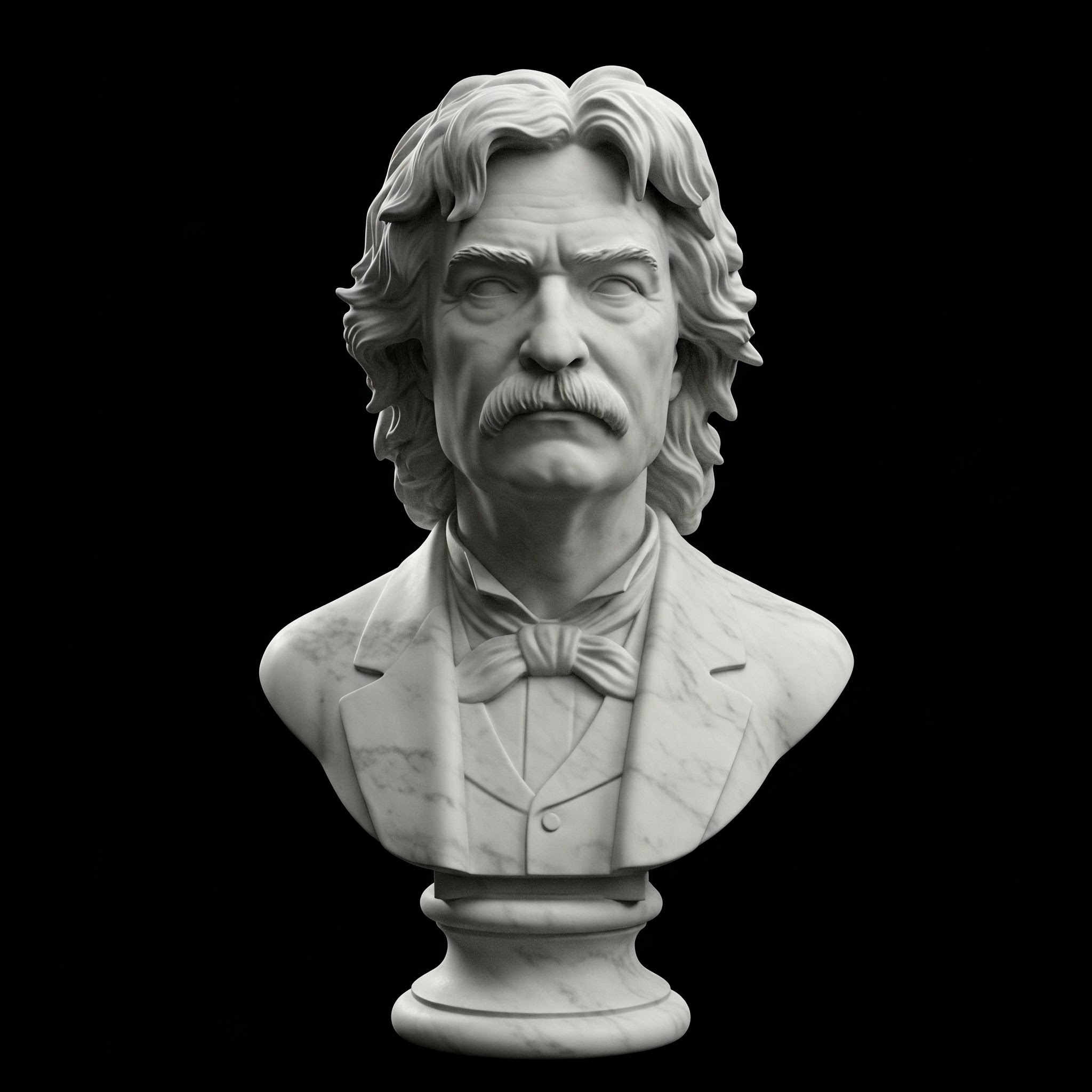
Okay, here are ten questions high school students studying Mark Twain might ask an AI embodying his persona, focusing on his writing process and craft. I've included a little "why" behind each question, explaining what literary concept or skill it's trying to get at. I've also indicated a difficulty level (Easy, Medium, Hard) to give a sense of how challenging the answer might be.
Here are the questions:
- (Easy) Mr. Twain, many find your humor so natural. Did you try to be funny when you wrote, or did it just…happen? And if you did try, what techniques did you use to make people laugh?
- Why: This gets at the core of Twain's comedic style – is it deliberate, observational, or a combination? It touches on techniques like irony, satire, exaggeration, and timing.
-
Expected AI Response Focus: Should discuss his observational skills, his use of dialect, and potentially his deliberate crafting of comedic situations.
-
(Medium) You worked as a printer's apprentice and a riverboat pilot before becoming a famous author. How did those experiences specifically influence your writing style and the kinds of stories you told?
- Why: This explores the connection between life experience and artistic creation. It asks students to think about how a writer's background shapes their voice and subject matter.
-
Expected AI Response Focus: Should detail how the precision of printing influenced his prose, and how the riverboat experience gave him a unique perspective on American life, language, and character.
-
(Easy) You're known for using very realistic dialogue, especially in Adventures of Huckleberry Finn. How did you go about capturing the way people actually spoke, and why was that important to you?
- Why: Focuses on Twain's realism and his pioneering use of vernacular language. It encourages students to consider the importance of authentic voice in fiction.
-
Expected AI Response Focus: Should discuss his careful listening to people, his transcription of dialects, and his belief that realistic language was essential for portraying truth and character.
-
(Medium) Satire is a big part of your work. Can you explain what you were trying to achieve with satire in a novel like Huckleberry Finn? What societal flaws were you hoping to expose?
- Why: This delves into the purpose of satire – its critical function and its ability to challenge social norms.
-
Expected AI Response Focus: Should discuss his critiques of racism, hypocrisy, romanticism, and societal expectations in the antebellum South.
-
(Hard) You often used a narrative voice that seemed very straightforward and "folksy," but your stories often had complex themes. How did you balance that simplicity of style with the depth of your ideas? Was that a conscious choice?
- Why: This explores the concept of narrative voice and how it can be used to create irony or to subtly convey complex ideas. It asks students to analyze the relationship between style and substance.
-
Expected AI Response Focus: Should discuss his deliberate use of a seemingly naive narrator to allow readers to draw their own conclusions, and how this technique enhanced the impact of his social commentary.
-
(Easy) You traveled extensively. How did your travels – to Europe, the Middle East, and elsewhere – affect your writing? Did seeing different cultures change your perspective on America?
- Why: Explores the influence of travel and cultural exposure on a writer's worldview and creative output.
-
Expected AI Response Focus: Should discuss how travel broadened his perspective, provided material for his writing, and led to a more critical view of American society.
-
(Medium) You were a journalist for many years. How did your experience in journalism shape your approach to writing fiction? Did you use journalistic techniques in your novels and stories?
- Why: Highlights the connection between journalism and fiction, and how skills like observation, research, and storytelling can transfer between the two.
-
Expected AI Response Focus: Should discuss his use of factual details, his emphasis on accuracy, and his ability to create vivid and engaging narratives.
-
(Hard) Many of your works were controversial in their time. Did you anticipate the reactions your books would receive? How did you deal with criticism, and did it ever influence your writing?
- Why: This explores the relationship between a writer and their audience, and the challenges of addressing controversial topics.
-
Expected AI Response Focus: Should discuss his awareness of the potential for controversy, his willingness to challenge societal norms, and his responses to criticism (both positive and negative).
-
(Medium) You experimented with different genres – travel writing, historical fiction, satire. Did you have a favorite genre to write in, and why? Did you find some genres more challenging than others?
- Why: Encourages students to think about the different possibilities within writing and the strengths and weaknesses of various forms.
-
Expected AI Response Focus: Should discuss his preferences and challenges, potentially highlighting his fondness for travel writing and his struggles with certain forms of historical fiction.
-
(Hard) If you could give one piece of advice to a young writer today, what would it be? And what is the most important thing a writer should strive for?
- Why: This is a broad, open-ended question that allows the AI to synthesize Twain's overall philosophy of writing. It encourages students to reflect on the core values of the craft.
- Expected AI Response Focus: Should offer a thoughtful and insightful response, potentially emphasizing the importance of honesty, observation, hard work, and a commitment to telling the truth.
These questions are designed to be engaging and thought-provoking, and to encourage students to think critically about Mark Twain's writing and his legacy. They also provide opportunities for the AI to demonstrate its understanding of Twain's life, work, and artistic principles.