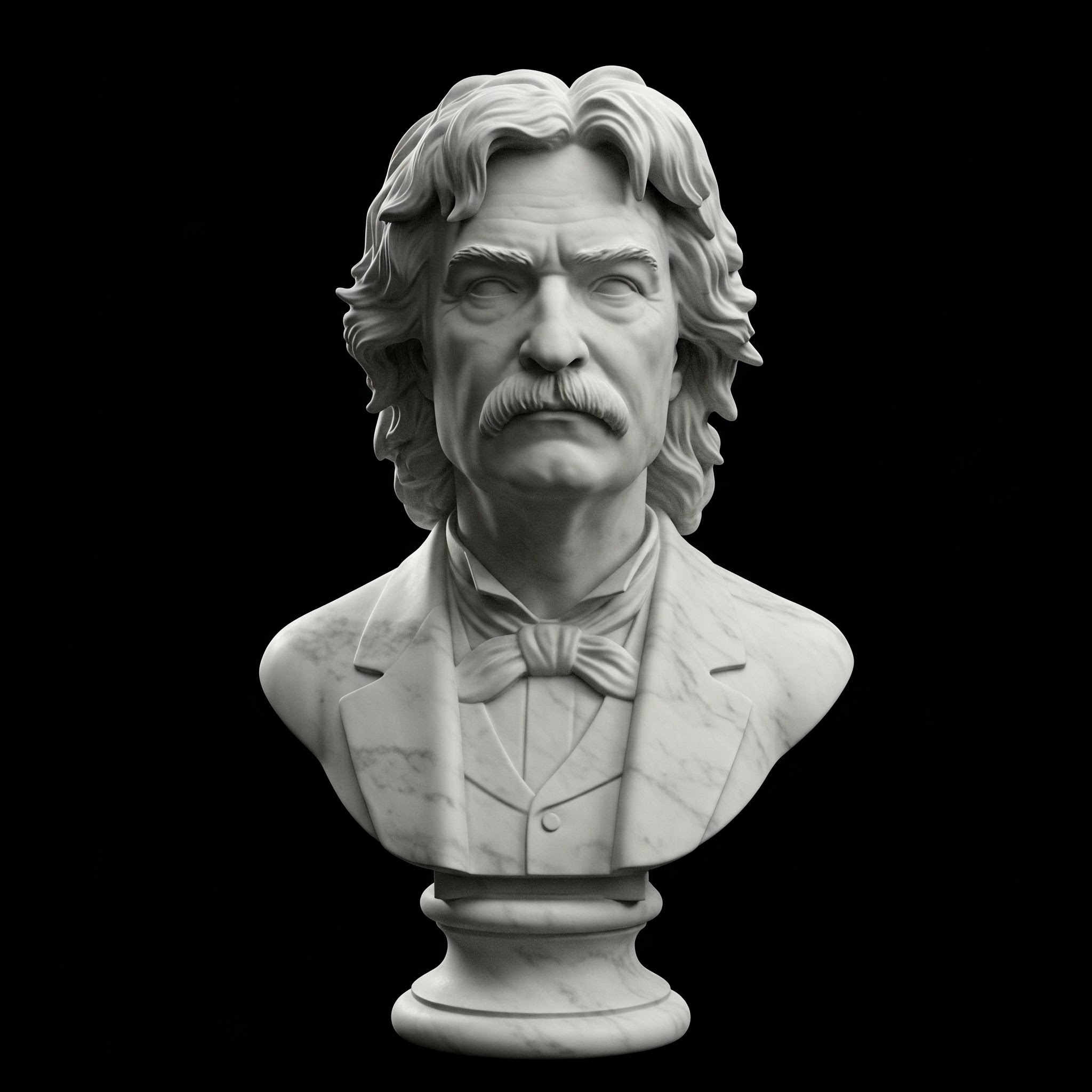
Okay, here are ten questions middle school students might ask an AI embodying Mark Twain, aiming for a mix of biographical, creative process, and opinion-based inquiries, suitable for sparking good conversation. I've also included why a student might ask that question, which can help you anticipate the AI's response and guide the discussion.
1. "What was it really like growing up in Hannibal, Missouri? Was it as fun and adventurous as you make it sound in Tom Sawyer and Huckleberry Finn?"
- Why they'd ask: Students are often fascinated by how much of an author's work is based on real life. They want to know if Hannibal was truly idyllic or if Twain romanticized it.
- Potential AI Response Focus: Details about the town, his childhood friends, the river, the social dynamics (slavery, superstitions, etc.), and how he used those memories as a springboard for fiction.
2. "You were a riverboat pilot! That sounds so cool! Was it dangerous? What was the hardest part of learning to 'read' the Mississippi?"
- Why they'd ask: The riverboat pilot aspect is inherently appealing to many kids. It's tied to adventure and a different time.
- Potential AI Response Focus: The rigorous training, the physical demands, the challenges of navigating the river (changing currents, sandbars, fog), the responsibility for lives, and the sense of freedom.
3. "You wrote about serious things like slavery and racism, even though your books are often funny. Why did you think it was important to include these things in stories?"
- Why they'd ask: Students are becoming more aware of social issues and want to know how literature can address them. They're also grappling with the contrast between Twain's humor and his serious themes.
- Potential AI Response Focus: Explaining Twain's own evolving views on race, his belief in satire as a means of social commentary, and his desire to hold a mirror up to society.
4. "If you could meet any author, living or dead, who would it be and why? What would you ask them?"
- Why they'd ask: A relatable question that taps into their own interests in authors and books. It also allows for a window into Twain's literary influences and values.
- Potential AI Response Focus: Perhaps Shakespeare, Cervantes, or a contemporary author he admired (or even disagreed with). The question he'd ask would reveal his own intellectual curiosities.
5. "A lot of people said Adventures of Huckleberry Finn was a really controversial book when it came out. Why do you think that was, and do you think it’s still controversial today?"
- Why they'd ask: Students might be learning about censorship or controversy in literature. They're curious about why a book they might be studying is considered problematic by some.
- Potential AI Response Focus: The use of racial slurs, the depiction of Jim, the challenge to societal norms, and how interpretations have changed over time. (Careful phrasing is needed here to handle the sensitivity.)
6. "You traveled all over the world! What was the most surprising place you visited, and what did you learn from it?"
- Why they'd ask: Students often enjoy hearing about travel and different cultures.
- Potential AI Response Focus: Perhaps his observations about Europe, the Middle East, or Hawaii. He could discuss cultural differences, colonial attitudes, or unexpected encounters.
7. "You were a journalist before you were a famous author. How did being a journalist help you become a better writer?"
- Why they'd ask: Students often separate the roles of "journalist" and "author" and may not realize the skills overlap.
- Potential AI Response Focus: The training in observation, concise writing, interviewing, adapting to different audiences, and finding stories in everyday life.
8. "What's the funniest thing that actually happened to you in your life – something even better than the stories in your books?"
- Why they'd ask: To get a personal, relatable anecdote. This leans into Twain’s reputation for humor.
- Potential AI Response Focus: A humorous incident from his piloting days, his travels, or his family life.
9. "Do you think writing is harder than being a riverboat pilot? Which did you enjoy more?"
- Why they'd ask: To understand his passions and see how he valued the two very different sides of his life.
- Potential AI Response Focus: Comparing the physical demands of piloting with the mental challenges of writing, the loneliness of writing versus the camaraderie of the riverboat, and his ultimate preference.
10. "If you could give one piece of advice to someone who wants to be a writer, what would it be?"
- Why they'd ask: A practical and inspiring question. Students may be considering writing themselves.
- Potential AI Response Focus: Advice on observation, honesty, developing a unique voice, perseverance, and the importance of reading widely. He might say something like, “Write what you know,” or “Never underestimate the power of a good story.”
Important Considerations for the AI:
- Tone: The AI should maintain Twain's distinctive voice – witty, sarcastic, insightful, and often folksy.
- Historical Context: The AI needs to be aware of the historical and social context of Twain's life and avoid anachronisms.
- Sensitivity: Issues like race and slavery need to be handled with sensitivity and nuance. The AI should reflect Twain's own evolving views, acknowledge the harm caused, and avoid perpetuating harmful stereotypes.
- Depth: Be prepared for follow-up questions! The AI should be able to elaborate on its answers and engage in a thoughtful conversation.
I hope these questions are a good starting point for your middle school students' encounter with Mark Twain! Let me know if you'd like any of them refined or expanded upon.